The story
In the Ming and Qing versions, Zhong Kui travels to the exams with his friend Du Ping. After Zhong Kui's death, the tale says he repays his friend's loyalty by marrying his younger sister to Du Ping, a scholar of good character (Chinese Wikipedia). Some popular tellings add that Du Ping had arranged his burial and that Zhong Kui returns from the underworld at the New Year to escort the bride.
The tale presents Zhong Kui not only as a terrifying protector but also as a brother concerned with his sister and family honor. That contrast helps explain why he can be both frightening and beloved. Read how the legend grew in the origin of Zhong Kui.
A pun in the title
A comic ghost procession
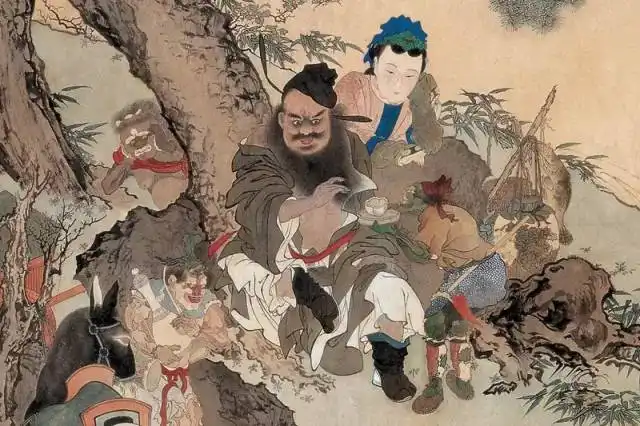
Paintings of this theme turn spiritual danger into controlled ceremony. In Gong Kai's Zhongshan Going on Excursion, Zhong Kui and his sister ride in sedan chairs with demon servants carrying his belongings (Smithsonian record). In Yan Geng's handscroll at the Met, Zhong Kui is drunk and propped on a small donkey by three attendants while his sister rides a stubborn water buffalo (The Met).
The Met suggests the artist may have drawn on New Year processions in which costumed performers playing Zhong Kui and his demons went through the streets for payment. It dates the scroll to the Yuan dynasty, though a 1470 colophon calls the artist a Southern Song figure.
Why it endures
The story rewards loyalty and teaches that appearances mislead: the man the court rejected for his face turns out to be the most dependable of brothers and friends. It also became a favorite of Chinese opera, performed as Zhong Kui Marries His Sister (钟馗嫁妹), and links naturally to the New Year customs described in Zhong Kui and New Year protection.
Further reading
Pages we consulted for this guide, each linked where it is used above. Check them if you want to go deeper or verify a detail.