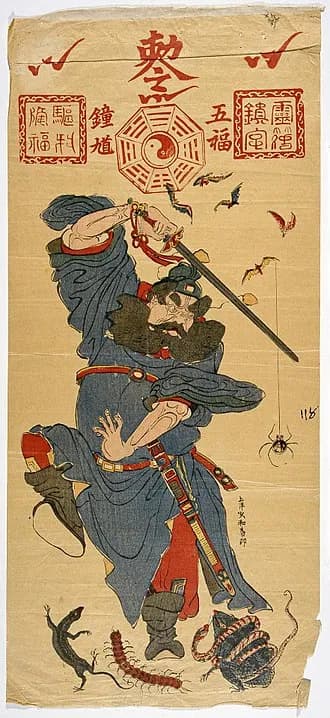
The sword and the fierce face
The sword is the most direct symbol of demon-quelling power. Japanese art dictionaries describe the standard figure as having large eyes, a bushy beard, black robes and an official's cap, often drawing or wielding a large sword against demons (JAANUS). It marks Zhong Kui as an active protector rather than a passive household image.
Bats and blessings
Bats appear often because the Chinese word for bat, 蝠 (fú), sounds like 福 (fú), "blessing" or "good fortune" (Cultural Keys). Five bats echo the "five blessings" (五福), which sources list as health, longevity, virtue, wealth and a graceful death, though the order and exact list vary.
A Ming dynasty painting in the Ashmolean Museum, Zhong Kui the Demon Queller with Five Bats, shows him holding a scepter and looking up at five bats while two demon followers hold a vase; its plum, pine and bamboo stand for perseverance (Wikipedia). A popular explanation adds that bats, which find their way in the dark, were imagined as helpers who locate hidden demons.
Ghost attendants
Small ghosts around Zhong Kui are not always enemies. In Gong Kai's handscroll Zhongshan Going on Excursion, a retinue of demon servants carries Zhong Kui's sword, bundles of household goods, pots of wine and smaller demons they have captured (Smithsonian record). This visual reversal makes Zhong Kui look powerful enough to command the very spirits that ordinary people fear.
Official dress, scholar and warrior
Zhong Kui usually wears the black cap, wide-sleeved robe and boots of a Chinese official. The costume recalls the examination success he was denied and presents him as a legitimate authority rather than a wild monster. Some artists lean into the scholar: Ren Bonian's 1883 scroll shows him seated and reading beside bronze vessels of flowers and fruit (The Met).
Wine and the Dragon Boat Festival
Zhong Kui is often shown with wine. In a Qing dynasty scroll by Fang Xun, wide eyes light up at a wine cup offered by a small demon (Shanghai Museum). The theme adds humor and warmth to an otherwise fearsome figure.
At the Dragon Boat Festival, hanging Zhong Kui pictures is one of the traditional protective customs, alongside pictures of the "five poisons" (snake, centipede, scorpion, lizard and toad, sometimes a spider) that the season was thought to bring (Wikipedia). Read more in Zhong Kui and the Dragon Boat Festival.
Further reading
Pages we consulted for this guide, each linked where it is used above. Check them if you want to go deeper or verify a detail.
- Shōki 鍾馗 — JAANUS (Dictionary of Japanese Architectural and Art Historical Terminology)
- Bet on the Bat: The Bat in Chinese Art — Cultural Keys
- Zhong Kui the Demon Queller with Five Bats — Wikipedia (Ashmolean Museum painting)
- Zhongshan Going on Excursion 中山出遊圖, Gong Kai (F1938.4) — Smithsonian National Museum of Asian Art
- Zhong Kui, Ren Yi (Ren Bonian), dated 1883 — The Metropolitan Museum of Art
- 方薰 钟馗像轴 — Shanghai Museum
- Dragon Boat Festival — Wikipedia