Why the fifth month felt dangerous
The Dragon Boat Festival (端午) falls on the fifth day of the fifth lunar month, which traditional belief regarded as an unlucky and "poisonous" month. Wikipedia lists the defenses: calamus, mugwort and garlic hung above doors for their strong smell and sword-shaped leaves, realgar wine daubed on children's faces, scented medicine pouches, and pictures of the five venomous creatures (snake, centipede, scorpion, lizard and toad, sometimes a spider).
From New Year to Dragon Boat
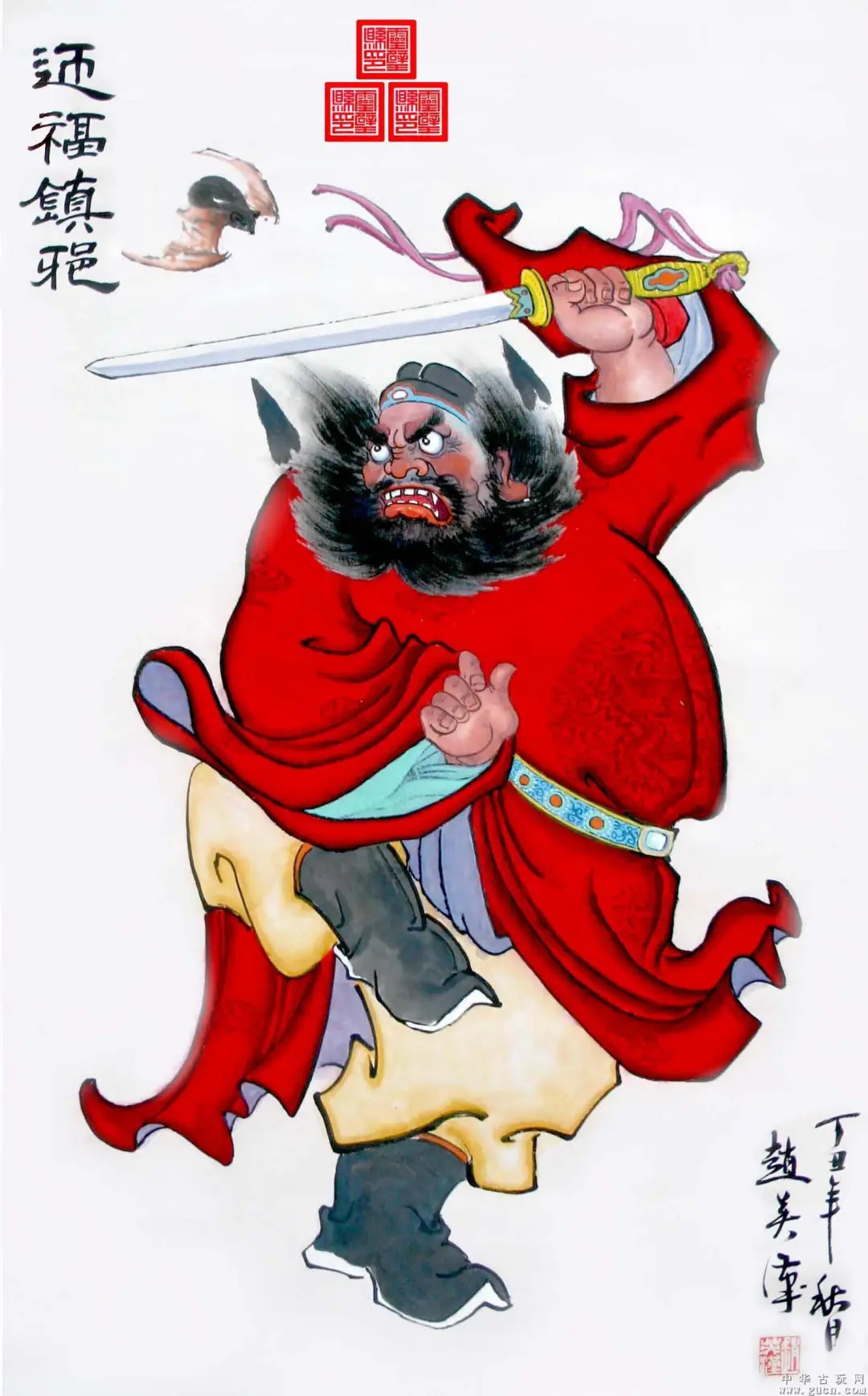
Zhong Kui pictures belong to the same family of protective customs, and the same article lists hanging Zhong Kui icons among the festival's activities. They were not always a Duanwu custom: the Palace Museum notes that Zhong Kui images were first hung at the New Year (see New Year protection), and that by the late Ming and early Qing the custom had shifted toward the Dragon Boat Festival (Palace Museum entry).
Chinese Wikipedia quotes the Qing-era Yanjing Suishi Ji, which records Beijing residents rushing to buy Zhong Kui pictures and paste them on the central door to keep out harmful influences (Chinese Wikipedia).
Zhong Kui as a festival guardian
Because Zhong Kui subdues demons and ghosts, his image fits naturally into the day's defenses. Hanging it makes the household threshold a symbolic boundary against harm, and the festival remains a popular occasion for painters to make new Zhong Kui pictures; see our guide to the symbols in Zhong Kui paintings.
Seeing the custom in art
The modern master Xu Beihong reportedly painted his well-known Zhong Kui at noon on the Dragon Boat Festival of 1938 in wartime Chongqing, continuing a long tradition of artists making Zhong Kui pictures for the day. The work appears on our art heritage page.
Further reading
Pages we consulted for this guide, each linked where it is used above. Check them if you want to go deeper or verify a detail.