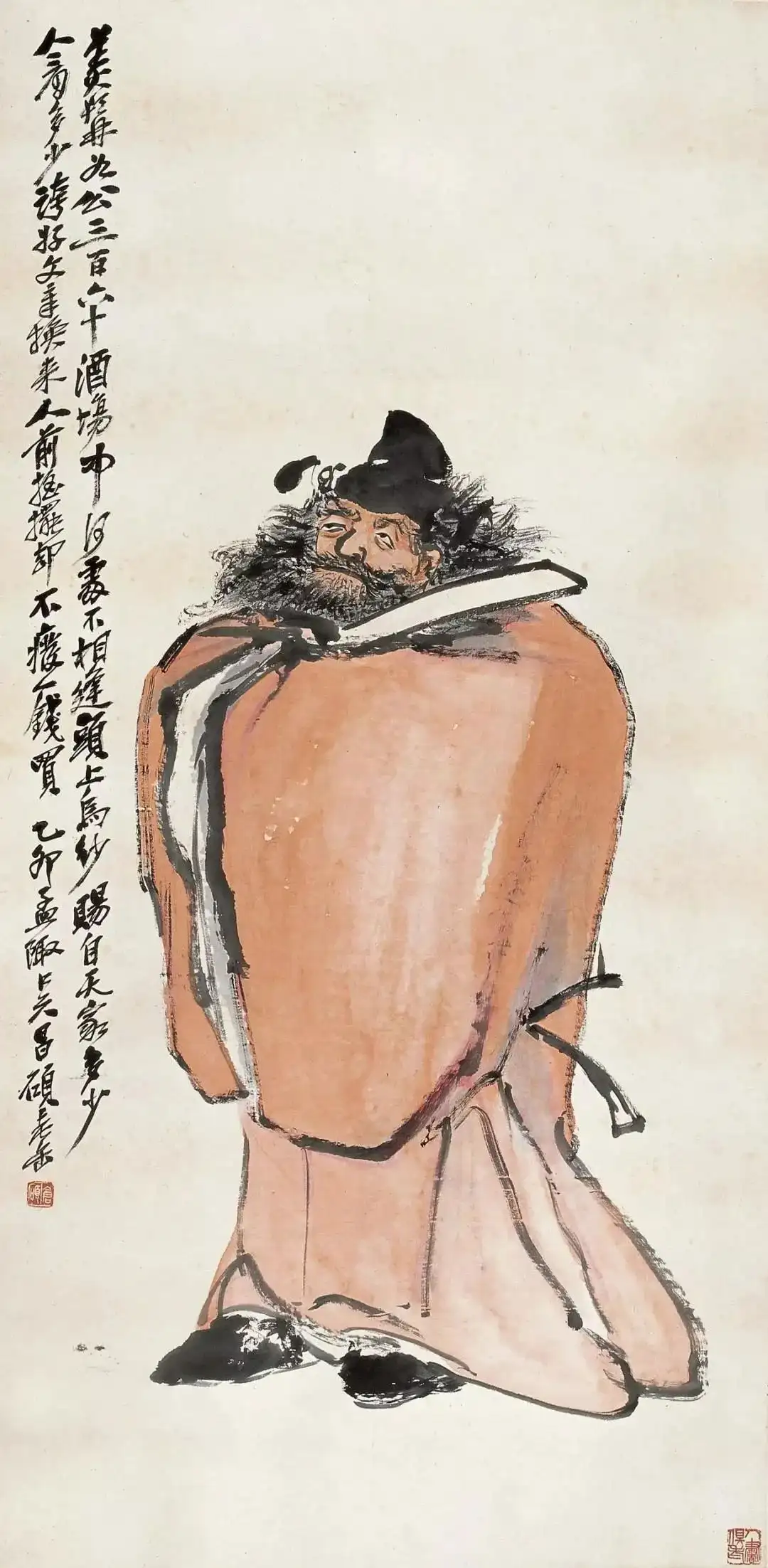
Two layers of the legend
The story has been told in two main layers. The older one comes from the Tang Yishi, quoted in the Ming anthology Tianzhongji: Zhong Kui is a man from Mount Zhongnan, near the Tang capital Chang'an, who fails the military examination in the Wude era (618–626), is shamed, and kills himself by dashing his head against the palace steps. The emperor grants him a green official's robe for his burial, and in gratitude Zhong Kui swears to rid the Tang of ghosts (Wikipedia).
The later layer, from Ming and Qing storytelling, makes him a literary prodigy. He travels to Chang'an with his friend Du Ping and writes the best essays of all the candidates, but the emperor refuses him the top place because of his disfigured face. This is the version most people know today, and it is the source of the idea that outward ugliness can hide a righteous heart.
From grievance to guardian
In the afterlife Zhong Kui gains a second calling. In the Tang legend he appears in Emperor Xuanzong's dream, catches a thieving small ghost, and vows to cleanse the realm of demons. Later novels and operas make him a king of ghosts and add the tale of marrying off his sister.
After the Song and Yuan dynasties, Daoism took him into its pantheon and honored him as "Saint Lord of Blessing and House Protection" (赐福镇宅圣君), according to Chinese Wikipedia.
Older than the stories?
Zhong Kui was already an exorcist figure in the Tang. Court minister Zhang Yue (667–730) and the writer Liu Yuxi (772–842) both wrote memorials thanking the emperor for a Zhong Kui painting and a new calendar given at year's end, and a manuscript from Dunhuang preserves a New Year's Eve invocation to Zhong Kui used in the Nuo exorcism ritual. Shen Kuo, the Song scholar who preserved the dream story, even notes that people named Zhong Kui were recorded before the Kaiyuan era (Shen Kuo's text).
One long-standing scholarly theory, associated with the seventeenth-century scholar Gu Yanwu, holds that the figure grew out of zhongkui (终葵), the name of a mallet-like implement used to drive off evil; the Zuozhuan mentions a clan of that name. Chinese Wikipedia summarizes this and other explanations and concludes that his origin remains unsettled, probably a personified protective object rather than a documented individual (see the entry).
Frequently Asked Questions
Was Zhong Kui a real historical person?
There is no proof that Zhong Kui lived as a documented individual. Scholars treat him as a legendary figure shaped by folklore, religious practice, and art, and his true origin remains unresolved.
Why is Zhong Kui shown with a fierce face?
In the later versions of the story his fierce face costs him his place at court, and in art the same frightening expression signals authority over ghosts and demons.
Where was Zhong Kui from?
Legend places him in the Zhongnan mountains near the Tang capital Chang'an, in what is now Shaanxi province.
Further reading
Pages we consulted for this guide, each linked where it is used above. Check them if you want to go deeper or verify a detail.