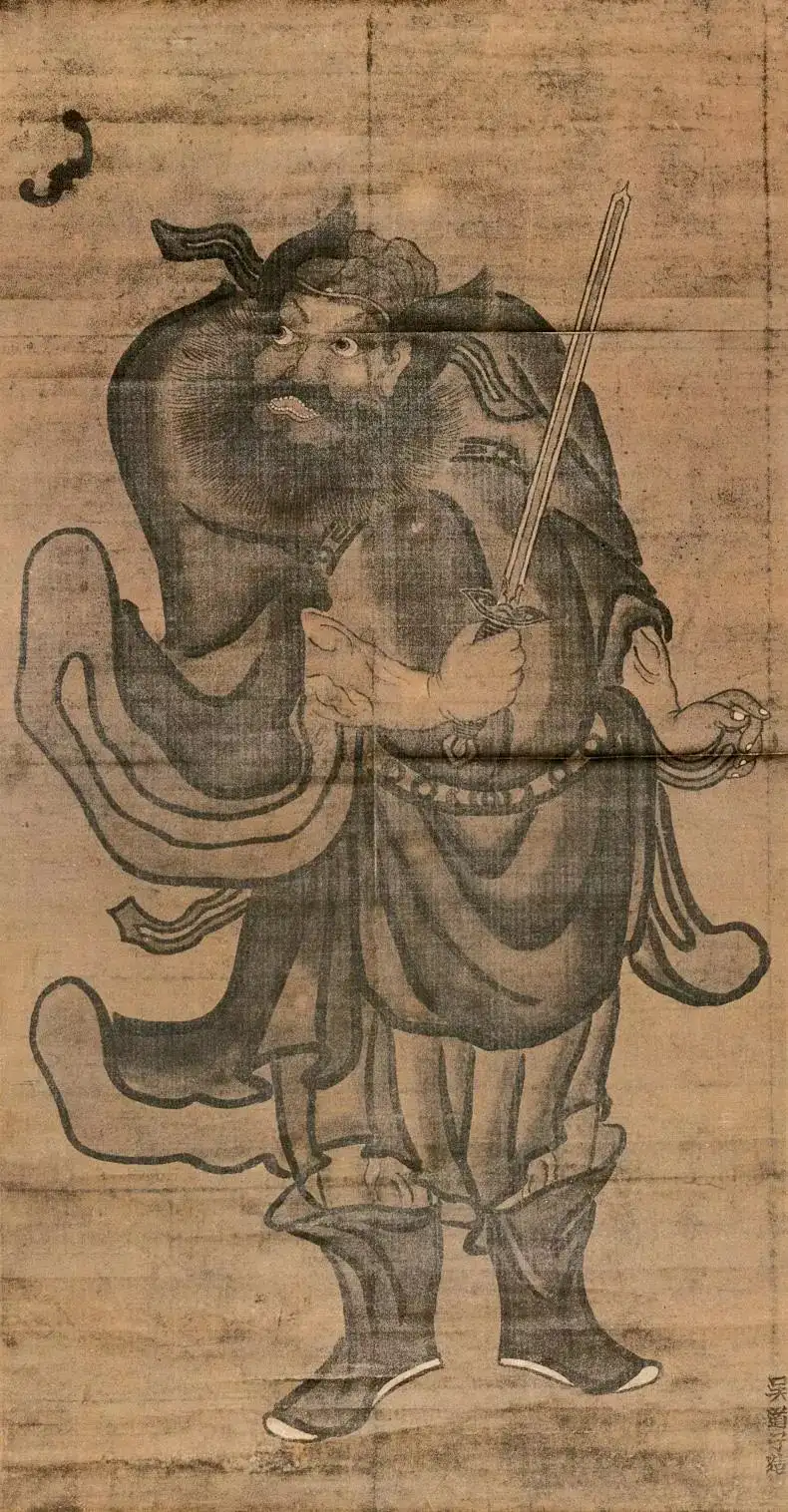
The painter of the dream
Wu Daozi (c. 685–c. 758, by one estimate) is remembered as one of the great painters of the Tang dynasty, and many legends tell of his commissions from Emperor Xuanzong. In the Zhong Kui legend he is summoned to record the figure seen in the emperor's dream.
An original that is known only through descriptions
No authentic original by Wu Daozi is known to survive, only later copies and stone carvings. His Zhong Kui is therefore known from written accounts, above all the inscription on a scroll attributed to him that Shen Kuo describes (Wikisource text).
Among the earliest surviving Zhong Kui paintings is the handscroll Zhongshan Going on Excursion by Gong Kai (1222–1307), a Song loyalist who painted under Mongol rule. The Freer Gallery dates it to the late thirteenth or early fourteenth century (Smithsonian record).
A model for later artists
The attribution to Wu Daozi gave later images a prestigious origin. The Shanghai Museum notes that the earliest depictions are credited to him and that Fang Xun's Qing dynasty hanging scroll, with its bristling beard and a small demon offering a wine cup, shows some influence from Chen Hongshou (museum entry).
Dai Jin's Ming dynasty Zhong Kui Traveling at Night, a 190 × 120.4 cm silk scroll in the Palace Museum, shows Zhong Kui carried through a snowy night by grotesque little ghosts, drawn with forceful "nail-head and rat-tail" lines (Palace Museum).
Ren Yi (Ren Bonian) took a different path in 1883, painting Zhong Kui as a seated scholar reading beside a table of bronzes filled with flowers and fruit (The Met). Even when artists changed the mood, the core image stayed recognizable: a fierce, official-like figure who commands spiritual power.
Why collectors and viewers care
Zhong Kui paintings often functioned as protective images for homes, shops, and seasonal rituals, so their value lies in both artistic technique and cultural use. Understanding the Wu Daozi tradition helps viewers read them as objects of belief, not only as portraits. See several of these works on our art heritage page.
Further reading
Pages we consulted for this guide, each linked where it is used above. Check them if you want to go deeper or verify a detail.
- Wu Daozi — Wikipedia
- Mengxi Bubitan (Supplementary Notes to Dream Pool Essays), Shen Kuo — entry on Zhong Kui — Chinese Wikisource
- Zhongshan Going on Excursion 中山出遊圖, Gong Kai (F1938.4) — Smithsonian National Museum of Asian Art
- 方薰 钟馗像轴 — Shanghai Museum
- 钟馗夜游图轴, Dai Jin — The Palace Museum, Beijing
- Zhong Kui, Ren Yi (Ren Bonian), dated 1883 — The Metropolitan Museum of Art