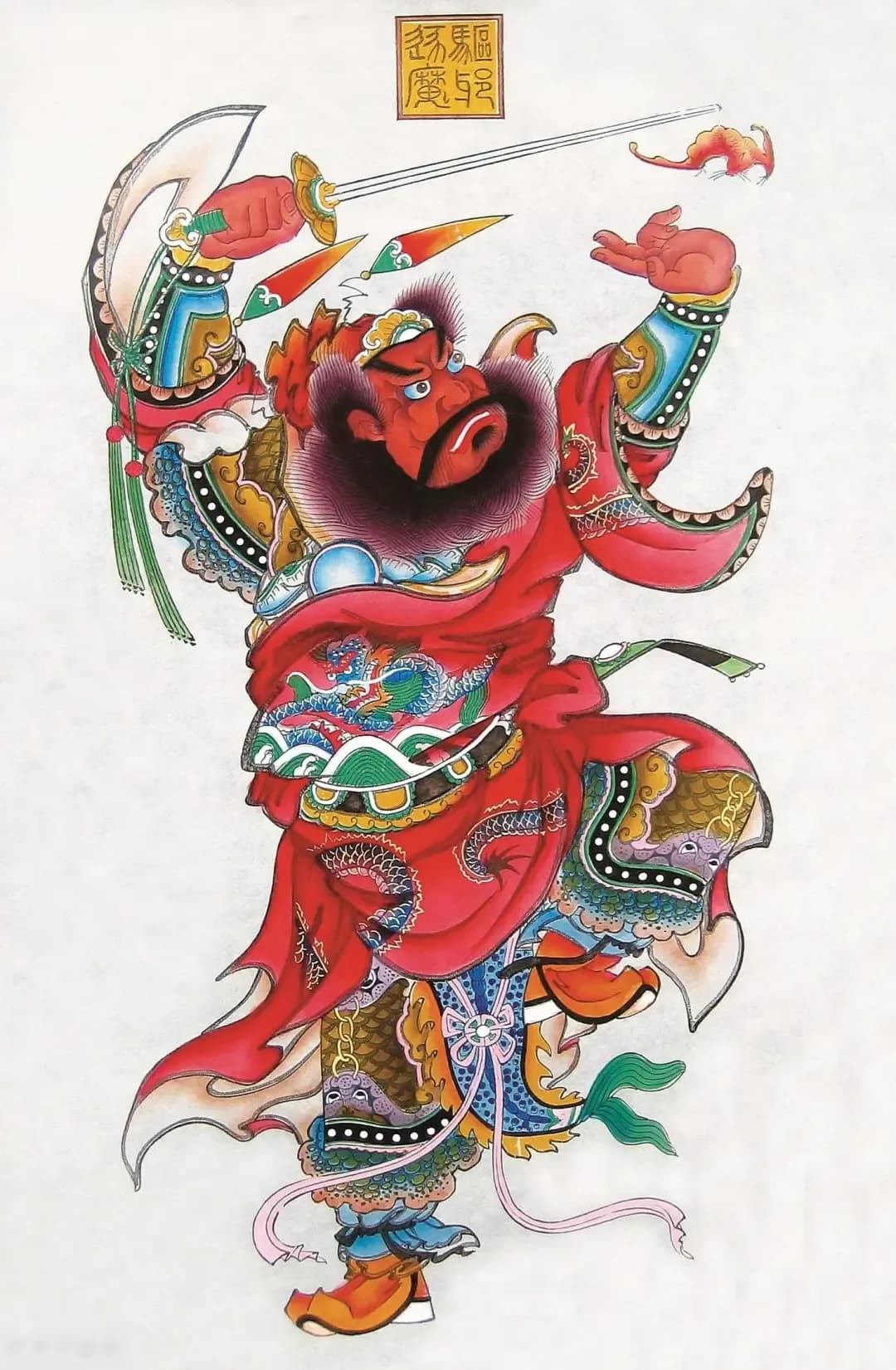
The characters and the pinyin
In Mandarin pinyin the name is Zhōng Kuí: Zhōng in the high, level first tone and Kuí in the rising second tone. The simplified 钟 stands for two traditional characters, 鐘 ("bell", "clock") and 鍾 ("wine vessel", "to concentrate one's love or attention"); the name uses 鍾 (Wiktionary). It has 9 strokes under the metal radical 钅.
馗 has 11 strokes under the radical 首 ("head"). Dictionaries list it as a literary variant of 逵, "thoroughfare", used in personal names (Wiktionary).
Spellings in other languages
Older and regional romanizations are still common in books and museum labels. You may see Chung Kuei or Chung Kwei (Wade–Giles gives Chung K'uei); Cantonese says Zung1 Kwai4; Korean Jonggyu; Vietnamese Chung Quỳ. In Japan, where he is also a popular protector, the same characters are read Shōki (Wikipedia), the subject of Shōki: Zhong Kui in Japan.
How to pronounce Zhong Kui
English speakers usually get close with "joong kway". The Mandarin "zh" is a soft, tongue-curled "j", and the vowel in "kui" glides like "way" in "kway". Tone matters in Mandarin, so native speakers will hear the difference, but the approximation is understood.
Where the name may come from
The characters do not describe the legend; the name is a label. Two explanations for its origin appear in Chinese Wikipedia. The seventeenth-century scholar Gu Yanwu argued that Zhong Kui grew out of 终葵, an old word for a ritual mallet used to drive off evil, which the Zuozhuan links to a clan that wielded such mallets. The Ming physician Li Shizhen noted a different reading, that the Erya dictionary glosses the term as the name of a fungus.
Neither theory is proven. Shen Kuo, writing in the eleventh century, already observed that people called Zhong Kui were recorded before the legend's Kaiyuan-era dream (Wikisource text), which is why the name is often treated as older than the story.
Titles and other names
Zhong Kui carries several honorifics. After the Song and Yuan dynasties Daoism honored him as "Saint Lord of Blessing and House Protection" (赐福镇宅圣君), and in many popular retellings he becomes a king of ghosts. For the story behind these titles, see the origin of Zhong Kui.
Frequently Asked Questions
How do you pronounce Zhong Kui?
Roughly "joong kway". In pinyin it is Zhōng Kuí, with a high level tone on the first syllable and a rising tone on the second.
Is it Zhong Kui or Chung Kuei?
They are two romanizations of the same name. Zhong Kui is the modern pinyin standard; Chung Kuei is an older Wade–Giles-style spelling still used in some books and museum labels.
How do you write Zhong Kui in Chinese?
In simplified characters it is 钟馗, and in traditional characters 鍾馗.
Further reading
Pages we consulted for this guide, each linked where it is used above. Check them if you want to go deeper or verify a detail.